My great-grandfather did not leave much of a trail to help me piece together a picture of the life he lived, but searches through paper, microfiche, and online records are slowly yielding results. I started with a list of family names and cemetery records, moved on to city directory and census records, then discovered digital indices of Irish tax records and Chicago newspaper obituaries.
The blips of information echo history lessons. An Irishman emigrates from a hard-hit famine county around 1850. A neighbor comes later with his young family, moves into lodging in the rear of the building, and joins in the construction business of his County Mayo neighbor. But this isn’t simply a story of famine, emigration, and a booming industrial city. It’s the story of my great-grandfather and an example of the many individuals that authored the larger story of Chicago.
My grandmother wrote that her father-in-law, James Renn, was from Ireland, had no known siblings, and that he was “killed” at about age 45. He died falling down the stairs at home, according to a story passed down orally in our family.
A typed cemetery card has a hand-written on it a note that James Wren was first interred 3/18/1879. Using this date, I searched through Chicago Daily News microfiche for a death notice. Peering through an old-school microfiche reader on the 3rd floor of the Chicago Public Library, I had an exciting find, a death notice for James Rinn, transcribed below:
RINN – Sunday, March 16, at 2 o’clock a.m., of concussion of the brain, caused by an accidental fall, at his residence. 387 Division st., JAMES RINN.
Family story confirmed and an exact date of death for my great-grandfather! The address in the newspaper, 387 Division St., was also hand-written on the copy of the cemetery record with yet another surname variation: James Renn.
With the address of 387 Division Street confirmed, I knew that City Directory listings in 1875 and 1876 were for my great-grandfather at his home.
Renn James, lamplighter, r. rear 387 Division
I have not found Chicago census data for my Renn great-grandparents, even now with a confirmed address on Division Street. Where was the Renn family in 1870 and 1880? I wondered who was living at 387 Division Street during those years. To find 387 Division in the censuses of 1870 and 1880, I searched for the address page by page. It was like following in the steps of the the census- taker as he walked up one street, crossed-over, walked down the block, and turned the corner. Finally, I landed on the right block and found 387 Division. There was not a Rinn or a Renn or a Wren there. The person living at 387 Division was John McHugh, age 50, his wife Mary and three children. In 1870, his occupation was recorded as “contractor.” In 1880, his occupation was recorded as street inspector.
The name McHugh rang a bell. I had found it while searching for my Renn ancestors in Ireland within the five counties that make up the western province of Connaught.
A second look at the Irish records confirmed that a James Rinn and a John McHugh were neighbors in Ireland. The Griffith’s Valuation in Ireland listed a family named Rinn, including a James, in the parish of Kilmactranny in Sligo, bordering Leitrim County. You can see the names of Rinn and McHugh on lines 7, 8, and 9 for the townland Rover in the Griffiths Valuation record below.

Note. Griffith’s Valuation was a property tax survey of Ireland published between 1847 and 1864 . It recorded detailed descriptions of all taxable land and buildings and the names of their owners and tenants. The counties of Sligo, Roscommon, and Leitrim border each other and, along with Mayo and Galway make up the five counties of the province of Connaught in Ireland.
Having seen many census records from 1880, the occupations of street inspector and lamplighter stood out as uncommonly similar. Were the two men friends? Did they know each other in Ireland? The funeral notice for John McHugh in the Chicago Daily News confirmed that my great-grandfather’s Chicago neighbor, John McHugh, was born near the location of the landholdings rented by the McHugh and Rinn families.
McHugh, John, at resid., 387 E. Division st., Dec. 21, 1890, native of Parish Mohill, Co. Leitrim, aged 65 yrs. Funeral from Immaculate Conception Church to Calvary
The obituary for John McHugh in the Chicago Tribune provides some evidence that the two men had a business relationship as well as a personal one. John McHugh may have employed my great-grandfather as well as provided housing when he immigrated to Chicago. The relationship with John McHugh may explain the plumbing business, property purchases, and inheritances that appeared in my grandfather’s family after his father’s death.
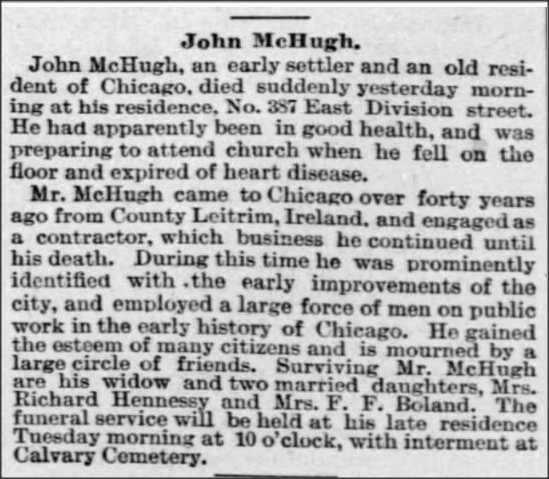
The only son of John McHugh is not mentioned in this obituary. He would have been 28 at the time of his father’s death in 1890, but had not followed him into the contracting business. He worked as a clerk for the city, never married, and died in 1937.
It was the Renn Brothers that continued as plumbing contractors for Chicago and other local municipalities in the growing city, although at a smaller level than their mentor John McHugh. For the Renn Brothers, as for John McHugh, the business did not continue into the next generation. The eldest Renn brother, Patrick, never married. My grandfather had three sons, all of whom died young. The third Renn brother, John, also died young.
It’s interesting to me how ephemeral it was. The work was a good living and brought stability to the families, but there was no empire building here. As the energy of a wave passes through, leaving the water in place, the business and the money also passed through. The next generation was lifted, but had to find its own way to provide and to rise. In my mind, though, what makes the business and the miles of water pipes laid through the streets of Chicago ephemeral is that the knowledge of this work was lost within our family. What we now have is built upon what they did then. It feels good to discover and acknowledge their efforts. To my ancestors I say thank you.

 One Chicago Family
Leave a comment