Nov. 22nd, 1928, two years after his arrival in Chicago, my dad wrote to his biological sister in Sweden:
I am in school every day and it is going well for me. Every month I have received prize in subjects I am good in. I started in first grade and now I am in fifth grade in one year and nine months. My sister Florence gives me lessons in piano so I play rather well. For Christmas we will have a play in school and I will be rescue soldier in white sailor costume. In my Summer vacation I was visiting my aunt in a villa community, was like in the country side. I had it so nice. We took photos so I send so Sonja can see how tall I have grown.
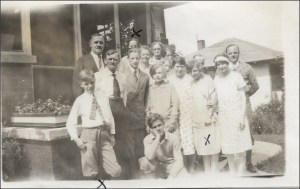
Thanks giving day we will celebrate at my aunt´s place outside Chicago and eat turkey. Soon it is Christmas and we will have a big Christmas tree and then I will help in dressing it. We have electric light in it. I mark out me and my sister Florence and mother on the photo so Sonja will know who we are.
Twelve-year old Rolly Johnson appeared to have adjusted well to his new life in Chicago, especially considering that he landed there after eight years growing up in a small farming community northwest of Örebro in central Sweden. From age three to ten, he lived with his adoptive family in in Närkes Kil: father Carl Johan Johansson/Johnson, mother Josephina, and older sister Florence. Carl and Josephine legally adopted him before they left Sweden for Chicago in 1926.
The Johnson family adopted my father because he was orphaned at the age of two when his mother and father died on the same day, April 29, 1919, victims of the flu pandemic that struck world wide in the aftermath of World War I. My father and his four siblings, including a twin brother, were cared for in their home by Karin (Ida Karolina), the younger sister of my dad’s mother Lydia Emilia, until they were adopted.
On May 26, 1919, the court in Örebro designated Viktor Nilsson as Guardian of the children and charged him with finding families to take care of the orphans. Viktor was the husband of Ester Amalia, Lydia Emilia’s older sister. The daughter of Viktor and Ester, Selma Nilsson, wrote to my parents, much later around 1980. She described how my father’s biological family stayed a part of his life and watched over him after his adoption.
We were there, the whole family, when Roland was baptized. Roland stood before a table, my sister and I stood on each side.
Carl and Josephine Johnson, my father’s adoptive parents, were both born in Sweden, but had emigrated to Chicago where they met and married in 1895. In Chicago they had two children, Florence and Roy. About 1912, the family returned to Sweden. Roy died in the flu pandemic in October 1918. The following year, the family took in little Roland.
In 1926, Carl, Josephine, Florence, and Roland left Sweden for Chicago. Carl, now known as Charles, worked as a special policeman in the Pullman community. Before returning to Sweden in 1912, he had worked for twenty years as a blacksmith for the Pullman Company.
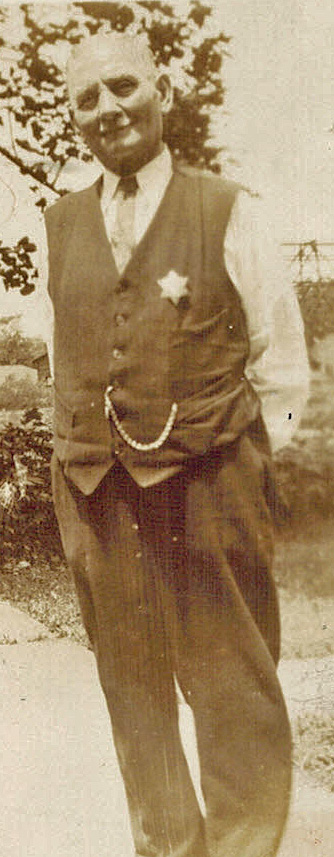
Charles Johnson, Special Police Office working at the Pullman Company
Note: Pullman was famous for its monopoly on the manufacture of sleeper cars, the creation of a company town in 1880, and the iron fist used by George Mortimer Pullman against his workers during the depression of the early 1890s and the Pullman Strike of 1894.
In this way, my father traveled from the place of his birth in central Sweden to Chicago at the age of ten. His life voyage was a tangle of secrets and lost memories, country life and city life, old family and new family. The letter that I quoted from above, written to his biological sister in 1928? It was signed from cousin Roland. My Dad’s re-connection with his birth family, and the revelation to his children that he was adopted and born in Sweden, didn’t happen until 1977. That – is another story.

 One Chicago Family
Leave a comment