The life of my grand-uncle took a tragic and near fatal turn as he was starting a promising career as a medical doctor in the 1890s. His estranged wife shot him in the head then emptied her revolver as he fell on the street near his home. Initial newspaper accounts were sympathetic to young Dr. Renn as he lay in the hospital, his fate uncertain. In the end, though, sympathies turned to his wife Sarah. The following year, a jury declined to indict her after hearing evidence that she was “goaded to desperation when she fired the shot.”
Thomas Hubert Renn was the youngest of five siblings and the only one born in the United States. He was just six years old in March 1879 when his father died at 2 a.m. on St. Patrick’s Day morning, in an accidental fall down stairs at home. Young Tom’s family moved out of 387 Division Street and into new rooms at 377 W. Division. Eldest son Pat, about 20 years old, became breadwinner for the family of six. He established himself in the plumbing trade and brought his younger brothers James and John into the business.
The family prospered, quickly and solidly. In November 1884 they purchased a large family plot at Calvary Cemetery and reinterred James Renn. By 1885 they were living in a four-story brick residence they bought at 227 Townsend Street. In 1887, 15-year-old Tom was enrolled at the H. B. Bryant School of Business in downtown Chicago. He went on to study medicine at the University of Illinois Medical College, graduating in 1892. While an intern at St. Elizabeth’s Hospital, he met 21-year-old Sarah McCarthy.
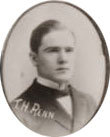
Thomas H. Renn
Tom and Sadie met in downtown Chicago at a news stand at 75 State Street owned by Sadie’s brother-in-law. Downtown Chicago at this time was crowded with people shopping and conducting business. An estimated 100,000 streetcar passengers passed by Marshall Field’s store daily (City of the Century, p. 268). New industries and a demand for women’s labor freed young women from the family home and the streetcars brought them and their money downtown.
Chicago was especially intoxicating and exuberant at the time Sadie and Tom met because of the World’s Columbian Exposition, open from May to October 1893. One can understand how they might have fallen under the spell of the White City, as much of Chicago did. Carried away by the excitement and changes of the times, Sadie and Tom transgressed norms and family expectations.
According to a later newspaper account, Tom was “attentive to her for several months” and “finally compelled” to marry her. Six months after their marriage, their daughter Nellie was born. Their romance turned out to be brief, with a long fade into tragedy.
Note. What I know of the sad story of Sarah and Tom is taken from newspaper accounts between 1895 and 1896. Newspapers of the day “had to be lively and entertaining as well as accurate” (City of the Century, p. 521). Newspapers were a lifeline for Chicago residents, of whom almost 80% were either immigrants or children of immigrants.
News articles reported that at the beginning of their married life, the couple, living at the Renn family residence at 227 Townsend, appeared happy. The family of Tom Renn, however, was not. “Renn’s relatives strenuously objected to the match in the first place and, it is said, never let an opportunity pass to make the young wife unhappy,” according to one newspaper report. Soon after the birth of Nellie, Sadie moved in with friends living at 248 Townsend, a building also owned by the Renn family. The daily proximity of Sadie and Tom fed resentment and neighborhood gossip as Sadie filed for divorce.
Eventually, Tom moved out of state to Alexander, Iowa. He practiced medicine there for six months before Sarah discovered where he was and had him arrested for abandonment in April 1895. One year later when Sara shot Tom, the case against him for abandonment was pending.
Newspaper accounts after the shooting were sympathetic to Sarah, portraying her as without means of support for herself and her baby, and desperate. Sadie would sit in her little room and watch the well-dressed Tom walk past her window “without a thought of her or their child.”
The shooting was a desperate act, yes, but not an impulsive one. Sadie had “for some time” been making threats against her husband. In May 1896, she decided to kill him. She borrowed money from her mother to purchase a revolver and a box of cartridges. The next day she waited inside a neighborhood store until Tom left his home. At 12:30 in the afternoon, she ran up behind my grand-uncle Tom Renn on the street. An eyewitness recounted that Tom leaned against a railing as Sadie asked him questions. He turned away without replying and Sadie drew a revolver from under her shawl. Her first bullet entered Tom’s head and he fell. “Then, standing over him, the woman emptied the revolver.” At age 25 Tom lay in critical condition in St. Joseph’s Hospital. Sarah, age 23, disappeared into an alley and fled to the house of friends to hide.
The hiding didn’t last long, although she wasn’t found by the police who searched the neighborhood house to house for her. The day after the shooting, she walked into the police Station on East Chicago Avenue and turned herself in to Captain Larsen. She may have made an astute reading of the times, given the tone of the newspaper coverage. Her brother being a Chicago policeman may also had encouraged her to rely on the justice system.
Tom recovered and Sadie was not charged. They lived separate and solitary lives. Sadie and Nellie lived with Sadie’s mother and siblings. Tom established a successful career as a medical doctor and lived alone. Nellie never married, worked as a stenographer at a insurance company, and died in her early 50s.
Sarah paid for her the sexual adventure of her younger self throughout her life. And Tom lived in the shadow of his early marriage and the objections of his siblings his whole life. Their story was of a brief love, a turbulent estrangement, and feuding families. Sarah and her family felt she was cheated out of her dower, supposedly a small fortune, by the Renn family. When Tom fled Chicago for Iowa, according to one newspaper account, it was to escape the feuding families.
The part played in this feud by Tom’s brothers and sister is another story, which I will leave for another day.
My mom made an entry in her list of wedding presents received in 1941, “Nellie – kitchen utensils – 51 pieces.” I truly hope that this is a record of Nellie Renn, my mom’s first cousin and the only child of her godfather Tom Renn. Nellie’s name is also in my grandmother’s family record. I hope she rose above the bitter fighting of her parents. I hope she was happy and at some point accepted by the Renn family. Most single women of modest means didn’t make much of an imprint in the records of the early 20th century, but perhaps I will find enough to be able to tell her story. I hope so.

 One Chicago Family
Leave a comment