He baptized us, he married us, and he buried us. My first cousin James Lester Mollohan was ordained a priest on May 3, 1951. He was a presence at every significant family event until his death in 2001. I knew him as the embodiment of the Catholic Church in our family. He represented the authority of the church and its right to lay claim to both our inner and outer worlds, its right to command obedience in body and in spirit.
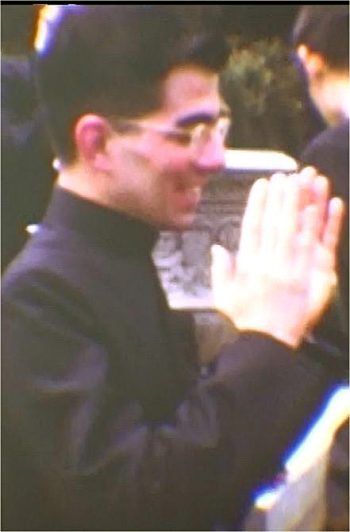
And yet Les (as we referred to him in the family) also represented a questioning of authority and the assertion of love over obedience. For 30 years, Father James Mollohan (his priestly name) served as a parish priest or pastor on the south side Chicago. During my teenage years, his was the challenging and questioning voice in our family. Arguments about race and civil rights were as much a part of our holiday dinners as turkey at Thanksgiving and lamb at Easter.
As I started writing up what I know about Les, there emerged a flickering double vision: revered priest and Peter Pan bachelor. In my mother’s eyes, perhaps he stayed the little boy who would comb her hair when she was a teenager. My father may have looked at Les and seen, not the priest, but the young teen who opened the bedroom door without knocking early on his first morning as a married man.
As a priest, Les worked long and hard, but his status in our family came from his role rather than his work. He usually arrived late for our family gatherings, sometimes so exhausted that he would immediately retire to a bedroom for a short nap before he joined family members sitting in a circle of chairs in our living room. We knew Les was likely to arrive late, but I don’t recall questions about his work that would help us understand why: a parishioner visited, funds found for a needy family, an apartment rehabilitated for affordable housing.
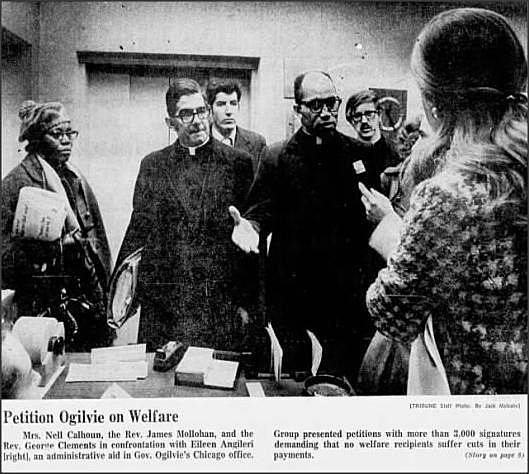
He also presented himself as living a charmed and expansive life. He was beloved in his parishes. He enjoyed music, travel, telling stories, and drinking whiskey. His voice and his laughter echoed through the house during family gatherings. He seemed to live large, always sure of himself, his place in the world, and his right relations with God.
Les was very modest about his work and didn’t voluntarily talk about it. In early spring of 2001, I approached him about letting me do a series of interviews about his work. My undergraduate degree is in history and my post-graduate degree is from a social science research program. I had spent years interviewing strangers. Now I wanted to use those skills to learn the largely hidden story of Les’s vocation and work.
Les agreed to my proposal, which led to a delightful day together. He asked if we could start our day with a trip to Calvary Cemetery, where most of our family is buried. We visited graves then took a tour around the north side of Chicago while Les reminisced about people and places of his childhood. In the afternoon, we sat in his sitting room at the rectory and I got out my digital recorder. But Les begged off talking about himself, promising that he would do so during our next interview. Instead, he told me stories of my grandmother, mother, aunts, and other relatives that had come alive for him as we drove around the city.
He gave me a great gift that day: the time we spent together and a record of many family stories. But I never did learn about his work. Les died a couple of months after what was to be the first of a series of interviews. It was at his funeral service that I heard stories about rehabilitating apartments and helping young people with college expenses. It was from his colleagues and parishioners that I learned how he was admired, appreciated, and loved.
If Les were alive today, he would be 93. Most of his cohort from St. Mary of the Lake Seminary and the people he worked most closely with in his parishes are retired or dead. At this point in time, I don’t know how much of his story I can uncover. The facts and conversations that would help me see the whole of Les are probably out of reach. I do, however, still have that tape recording of Les telling stories of his childhood and our family. He brought his whole self to the telling of those stories, and he is right there sitting across from me if I close my eyes and listen.

 One Chicago Family
Leave a comment