Ten year old Sigurd Roland Johnson stepped off the ship Gripsholm at Ellis Island on December 3, 1926, with his mother, father, and older sister. Their ship had pushed through a northwest gale to reach the end of a ten-day journey from Gothenburg, Sweden. More storms, social and economic, awaited Roland in his new home. The Immigration Act of 1924 established a national quota system and reflected the suspicion and animosity that now greeted new arrivals. On the horizon was the stock market crash of 1929, 25% unemployment, a militant sit-down strike at General Motors, and fears of a fifth column in the United States as Europe descended into war.
In these uncertain times, my 22-year-old father, Roland Johnson, first learned that he was adopted and brought into the United States illegally. My father was born in September, 1916, in south central Sweden. For the first two years of life, he lived in the small city of Örebro with his twin brother and three older siblings. His life course changed when his mother and father died in the flu pandemic that followed World War I. Little Roland soon found a home with Charles and Josephine Johnson, farmers living in a nearby hamlet who had returned to Sweden in 1912 after living in Chicago for over two decades. In 1926, the Johnson family once again immigrated to Chicago, entering the United States at Ellis Island on visitor visas.
Josephine Johnson kept the adoption secret from my father. She wrote in a letter to Sweden, I didn’t tell little Roland that I wasn’t his original mother, now I can’t. Josephine died in 1937 and I believe that soon thereafter, my father was told that he was an adopted son. At this time, he was about 22 years-old, recently graduated, and employed by Zenith Radio Corporation.
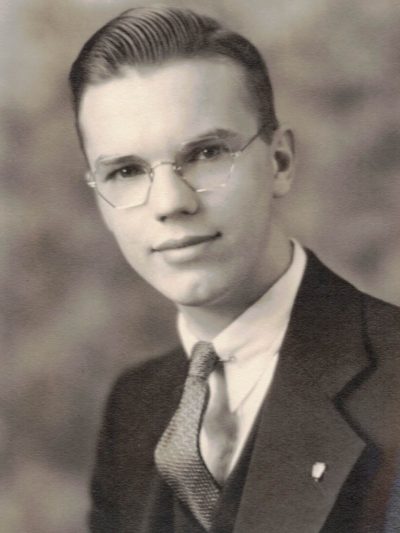
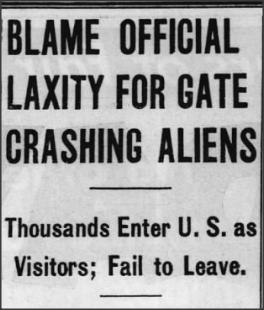
More concerning than his adoption, perhaps, was his immigration status. In the 1920s, the United States established national quotas and a border patrol to limit the number of immigrants. The depression of the 1930s fueled fears of cheap labor and foreign radicalism, morphing into fears of a fifth column as the world lurched towards another world war. My father would have anxiously read the headline below in the May 7, 1939, edition of the Chicago Tribune:
I grew up not knowing that my father had been born in Sweden in 1916, orphaned at age two, adopted, and brought to the United States in 1926. I also didn’t know that for decades my father hid his status as an illegal resident while attempting to get a certificate of citizenship from the Immigration and Naturalization Service. When he finally obtained this certificate in 1967, he did so on the basis of falsely representing the circumstances of his birth. Respectability, stability, and self-sufficiency defined my father – or so I thought. The ground under my feet rocked when, after his death, I learned of his secret and his deception. I couldn’t recognize my father in the picture drawn by these facts.
My father lived a long time with his precarious status and secret deception. My father, who, to me, lived an orderly and rule-bound life: oatmeal every morning at 7 a.m.; meat and potatoes every evening at 5:30 p.m., except on Tuesdays, his bowling night; Mass every Sunday morning. But his life was more complex than I could comprehend. Growing up, I saw him as principled, respectable, and at times dogmatic and rigid. Even now, I simply can’t picture him as skirting close to perjury. For my older sister, though, the picture of my dad falsifying his applications to the Immigration and Naturalization Service is not so jarring. Dad was happy with his job, and the success he had, my sister mused. He may have felt that this was a necessary evil that he just had to do.
I believe that my childhood perceptions of my father were essentially true and that circumstances drove him to act in a way that strained his character and beliefs. Today we are once again pummeled with headlines and bombastic warnings about immigrants. Those here without legal documents are often characterized as cheaters, unfairly skipping ahead of honest law-abiders. I can no longer hear those arguments without thinking of my father, an honest, law-abiding man who did not have a safe or easy option. I don’t fault him for what he did. I would do the same. And when I see the pictures of parents wading through turbulent waters with their children, now I also think, I would do the same.


 One Chicago Family
Leave a comment