My grandfather, Charles Johnson, was born into a 19th century old-world rural life and died in the midst of a 20th century urban and industrialized one. He was born in 1862 in Nora, a mining center in the Swedish county of Örebro. He died in 1947 in Chicago, after decades of work at the Pullman rail car company – first as a blacksmith and, in his 60s, as a security guard. With his metal-working skills, he rode the wave of the industrial revolution, from iron mines in central Sweden to machine blacksmith shops at Pullman. He crossed the Atlantic Ocean four times and lived through two Great Depressions (during the 1890s and 1930s) and two World Wars.
Charles Johnson was my father’s adoptive father. The wave that carried Charles carried many: over seven million people immigrated to the United States between 1877 and 1900. They mostly came from Germany (28%), Britain (18%), Ireland (15%), and Scandinavia (11%) and settled across the northern part of the United States.[1] The Homestead Act of 1862 opened up land in the west, native peoples now driven out. Five transcontinental railroads were built between 1869 and 1900. Labor was needed and rising birth and survival rates in Europe pushed people to leave their home countries for North America.
My grandfather Charles made the trip from central Sweden to the United States in 1885. Then known as Karl Johan Jansson, parish records of the Church of Sweden state that he was an unmarried 22-year-old laborer who emigrated alone. In 19th century Sweden, parish priests maintained records on births, marriages, deaths, religious education, and movings-in and-out of the parish. Birth records for Charles note that his father, Jan Henrik Andersson, worked in the mining industry at Sandvik, a corporation that still exists, making tools and equipment for the global mining industry.
A handwritten note in his funeral book relates that my grandfather arrived in New York in 1885 at age 22. He stayed in New York for six months, then moved on to Bradford, Pennsylvania; Muskegon, Michigan; and Chicago. Bradford was an oil boom town in the second half of the 19th century and home to the Bradford & Foster Brook Railway. Charles may have been using iron working skills learned alongside his father as he worked his way from the East Coast to Chicago.
On August 28, 1892, in Chicago, Charles married Josephine Molin, who had also emigrated alone from Örebro. They settled in the southern reaches of Chicago, living on south Michigan Avenue about a mile from the Pullman Palace Car Company. Charles was first employed by Pullman in 1892, according to his obituary. He worked there as a blacksmith for 20 years until he and his family returned to Sweden in 1912.
In the intervening years, two children were born to Charles and Josephine: Roy Louis on December 3, 1892, and Florence Inga on April 4, 1897. The membership book of Elim Lutheran Church records that the Johnson family was received into the church on August 25, 1901, a few days after Roy and Florence were baptized. Roy was confirmed in the church on March 31, 1907, and Florence was confirmed on June 4, 1911. The church membership book records that the family of four were “removed and dismissed” on July 1, 1912, for relocation to Kill, Sweden.
Something happened around 1910 that deflected the family’s course back towards Sweden. Or perhaps it was simply Josephine’s longing to live near her older sister Hulda. In 1910, Charles and 17-year-old Roy were both employed at Pullman. In the same year, Josephine and 13-year old Florence traveled to Sweden to scout property near the home of Hulda, who was then living on a farm near her husband’s birthplace about 15 miles northwest of the city of Örebro.
The Johnson family would live on that farm in Närkes Kil for 14 years. In 1926, the family returned to the Pullman neighborhood of Chicago. Florence was 29 years old and single. Roy was dead, buried in the church graveyard at Närkes Kil. In Roy’s place, Charles and Josephine traveled with their adopted ten-year old son, Sigurd Roland, my father, transplanted from a small farm in Sweden to the dense, multi-ethnic industrial neighborhood of Pullman. He thrived and grew into a thoroughly Chicago man.
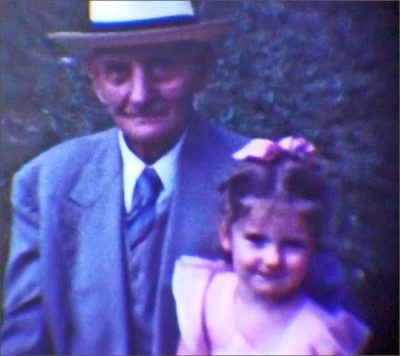
I never met my grandfather. He died five years before I was born. We have 16 mm film from the 1940s and there I can see my grandfather. At a family picnic a year before he died, he looks dapper in a three-piece suit, straw hat, and my older sister on his lap.
I feel that I can see the strength and vigor that carried him across continents and oceans and through a strenuous life. As a young man in Sweden, he labored on farms and in the metal-working industry. At age 50, he retired from blacksmithing and took up farming on a smallholding in Sweden. There he buried his 26-year old son and took in a two-year old orphan. At the age of 64, he returned to Chicago with his family, supporting them through the Great Depression with his work as a security guard at Pullman.
In the course of his life, Charles moved fluidly from the 19th century to the 20th century, from rural old-country to urban new world. His skills – a capacity for hard work, a willingness to love and to take risks, and the will to persevere – transcended centuries. Those skills served him well and he taught them to his his son, my father. I am grateful to my grandfather for this bequest to our family.
References
[1]Richard White, The Rise of Industrial America, 1877 – 1900, accessed October 1, 2019, at https://www.gilderlehrman.org/history-now/essays/rise-industrial-america-1877-1900.


Leave a Reply